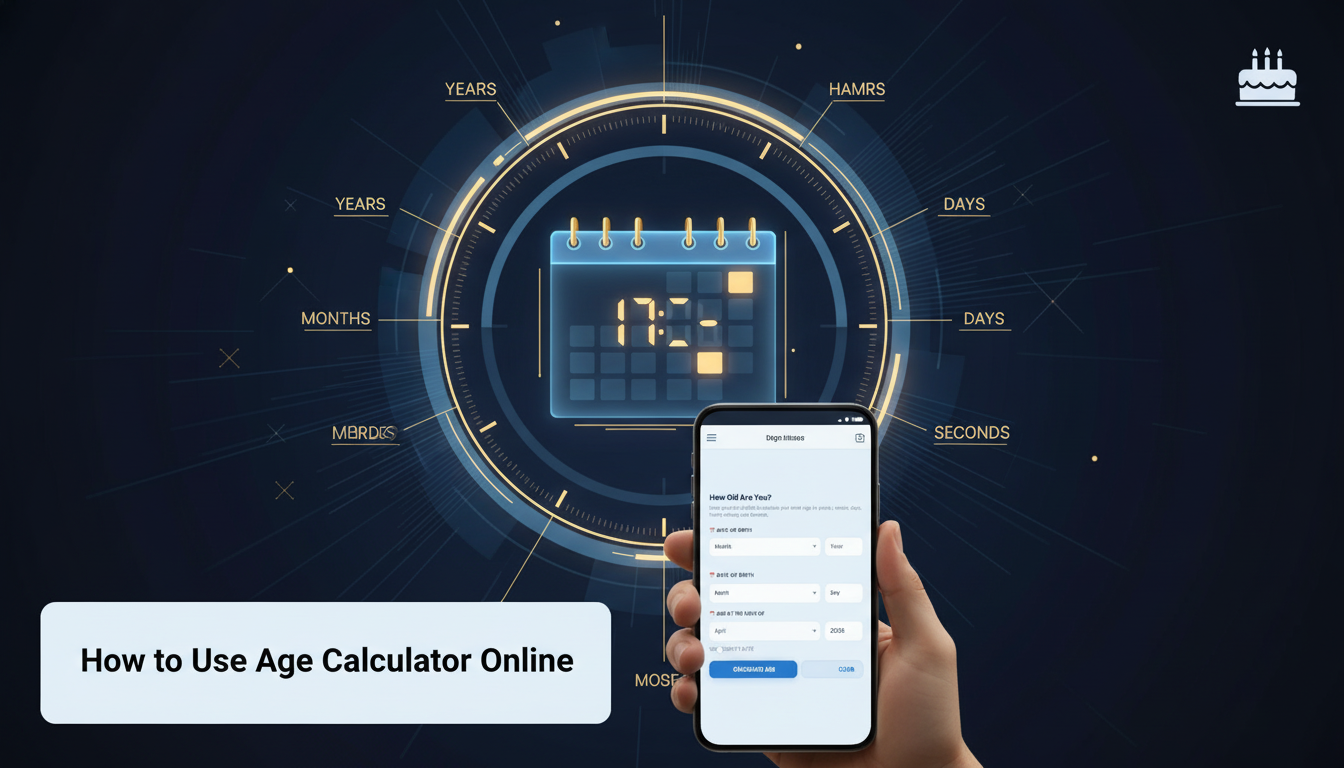
Summary: An online age calculator is a free, instant digital tool that computes your exact chronological age — in years, months, weeks, days, hours, minutes, and even seconds — simply by entering your date of birth. Whether you need your precise age for legal documents, medical records, school enrollment, retirement planning, or just personal curiosity, this comprehensive guide walks you through everything you need to know: how these tools work, how to use them step by step, why they outperform manual calculations, how they handle leap years, and who benefits most from them. By the end, you’ll understand exactly how to get the most accurate, reliable age result online in just a few clicks.
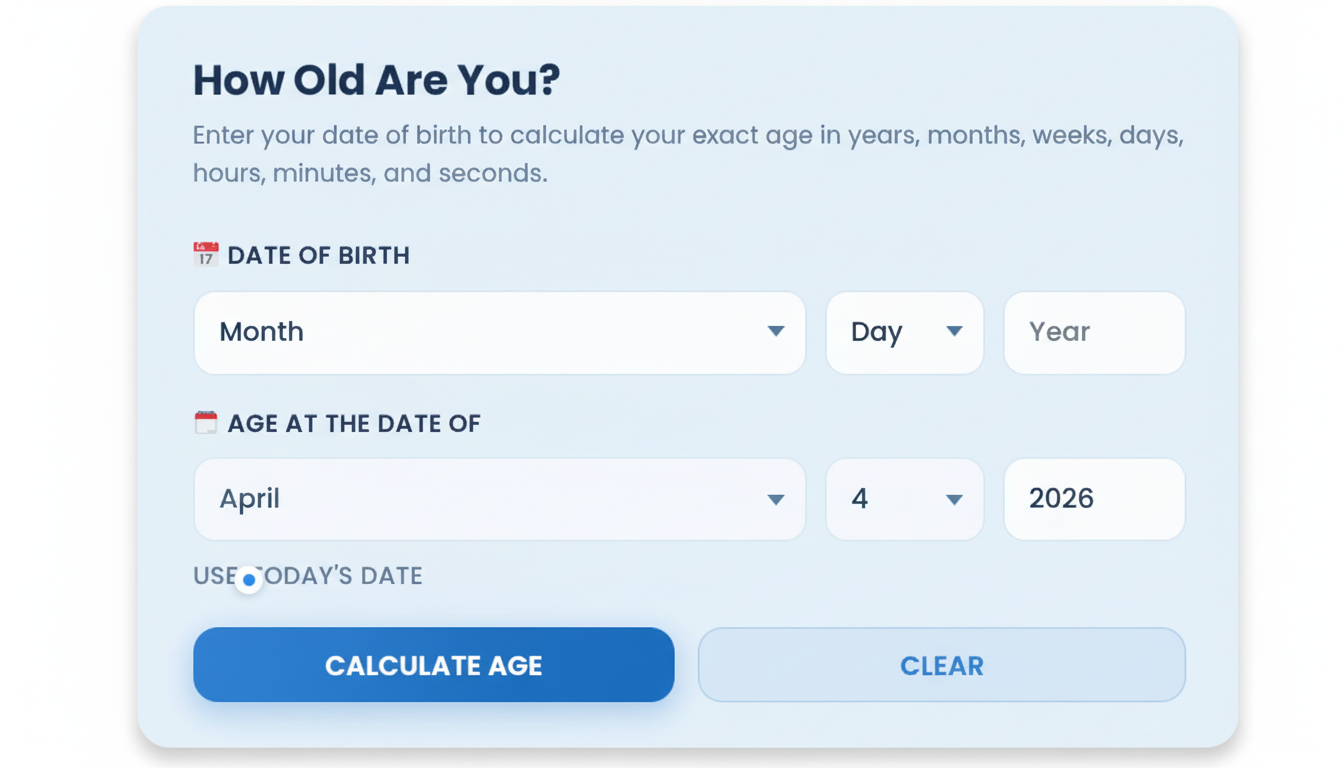
Table of Contents (Outline)
- How to Use Age Calculator Online: Complete Step-by-Step Guide (2026)
- What Is an Online Age Calculator?
- Why You Need an Exact Age Calculator (Not Just Year Subtraction)
- Step-by-Step Guide: How to Use the Age Calculator Online
- What the Age Calculator Results Actually Show You
- How Age Is Calculated — The Science and Math Behind It
- Who Should Use an Online Age Calculator?
- Age Calculator vs. Other Methods — A Full Comparison
- Common Questions About Age Calculation (LSI and NLP Coverage)
- LSI Keywords, NLP Terms, and Related Topics Covered
- Tips to Get the Most Out of Your Age Calculator
- Frequently Asked Questions (FAQ)
What Is an Online Age Calculator?
An online age calculator — also commonly searched as a date of birth calculator, exact age finder, age in days calculator, or how old am I calculator — is a free browser-based tool that determines a person’s precise chronological age by computing the difference between their birth date and a chosen target date (most commonly today’s date).
Unlike a simple mental subtraction of birth year from current year, a properly engineered age calculator accounts for every variable that affects time measurement: the total number of days in each month, the occurrence of leap years, partial months, and calendar edge cases. The result is an age figure that is accurate down to the day, hour, minute, and second — not just a rough approximation by year.
Tools like the Age Calculator on FastTaskTools take this even further, delivering a full breakdown of your age across every measurable unit of time — making them among the most detailed free age calculation tools available online today.
How Does an Age Calculator Work?
At its core, an age calculator works through a process called chronological age computation. Here is the underlying logic:
- The tool records your date of birth (day, month, year).
- It records the target date — either today’s date (auto-filled in most tools) or a custom date you choose.
- It calculates the total number of days between the two dates, accounting for every leap year and the varying number of days in each month.
- It then converts this day count into years, months, remaining days, total weeks, hours, minutes, and seconds.
The calculation follows the Gregorian calendar — the internationally standardized civil calendar used in almost every country around the world. Age increments on the exact anniversary of the birth date (your birthday), not at the start of a new year. This approach is known as the Western reckoning method and is the global standard for legal, medical, and administrative age determination.
According to the National Institute of Standards and Technology (NIST), precise timekeeping and date computation underpin critical systems in science, law, healthcare, and everyday life — making accuracy in date-based calculations far more important than most people realize.
Chronological Age vs. Biological Age — What’s the Difference?
It’s worth clarifying a common NLP-adjacent concept: chronological age vs. biological age.
- Chronological age is the objective count of time elapsed since your birth — the number calculated by an age calculator. It is universal, measurable, and legally binding.
- Biological age is a health science concept that estimates how well (or poorly) your body has aged relative to your chronological years. It factors in genetics, lifestyle, diet, and medical history.
An online age calculator measures chronological age exclusively. It tells you exactly how long you have existed in linear time. Biological age assessments are a separate, medical or wellness-oriented measurement.
Why You Need an Exact Age Calculator (Not Just Year Subtraction)
Most people default to a quick mental calculation: current year minus birth year. While harmless for casual conversation, this method is surprisingly unreliable in any context that demands precision.
The Problem with Manual Age Calculation
Manual age calculation by year subtraction creates systematic errors:
- Pre-birthday error: If your birthday hasn’t occurred yet this calendar year, subtracting the years gives you an age that is one year too high.
- Leap year blindness: People born on or around February 29th, or calculations that span multiple leap years, accumulate small day-count errors.
- Partial month confusion: Determining whether you are “5 months and 12 days” or “5 months and 13 days” into your current year of life is nearly impossible manually.
- No sub-year breakdown: Manual methods give you years only — not weeks, days, hours, or minutes.
- Human error rate: Especially for dates far in the past, mental arithmetic becomes unreliable quickly.
A dedicated online age calculator eliminates all these failure modes instantly and at zero effort.
Real-World Scenarios Where Exact Age Matters
| Scenario | Why Precision Matters |
|---|---|
| Legal documents (passport, visa, ID) | Exact DOB and current age in years/months may be required |
| Medical appointments | Patient age in months matters for dosage and screening |
| School enrollment | Cutoff dates are strict to the day in many districts |
| Pension and retirement | Eligibility thresholds are legally tied to exact birth dates |
| Insurance applications | Age brackets affect premium calculations |
| Sports eligibility | Youth categories have strict age cutoffs |
| Inheritance and probate | Age milestones trigger legal transitions |
| Citizenship applications | Age at time of application is legally documented |
Step-by-Step Guide: How to Use the Age Calculator Online
Using an online age calculator is designed to take under 60 seconds. Here is a detailed walkthrough using the FastTaskTools Age Calculator as the reference tool.
Step 1 — Enter Your Date of Birth
Navigate to the Age Calculator and locate the Date of Birth input section. You will see three dropdown fields:
- Month — Select your birth month from a full list (January through December)
- Day — Select the specific day of your birth (the day options automatically adjust based on the selected month and year, preventing invalid dates like February 30th)
- Year — Enter or select your four-digit birth year
Pro Tip: Take your time selecting the correct values. An error in any single field — especially the year — will produce an entirely incorrect result. Double-check before proceeding.
Step 2 — Set the Target Date
Directly below the Date of Birth fields, you will find the “Age at the Date of” section. This is where you specify the date against which your age will be calculated.
By default, a “Use today’s date” toggle is enabled, which automatically fills in today’s date (April 4, 2026 at time of writing). This is the most common use case — calculating your current age right now.
However, if you need to calculate your age on a specific past or future date, simply:
- Toggle off the “Use today’s date” option
- Manually select the target month, day, and year from the dropdown menus
This is particularly useful for:
- Calculating your age at the time of a past event
- Determining if you will be old enough for something on a specific future date (e.g., a license exam, a voting deadline, a retirement date)
- Historical research involving age at time of death or notable events
Step 3 — Click “Calculate Age”
Once both dates are confirmed, click the “Calculate Age” button. The tool processes your inputs instantly — no loading screen, no waiting, no page refresh. Results appear immediately below the input section.
Step 4 — Read and Interpret Your Results
The results section is divided into two parts:
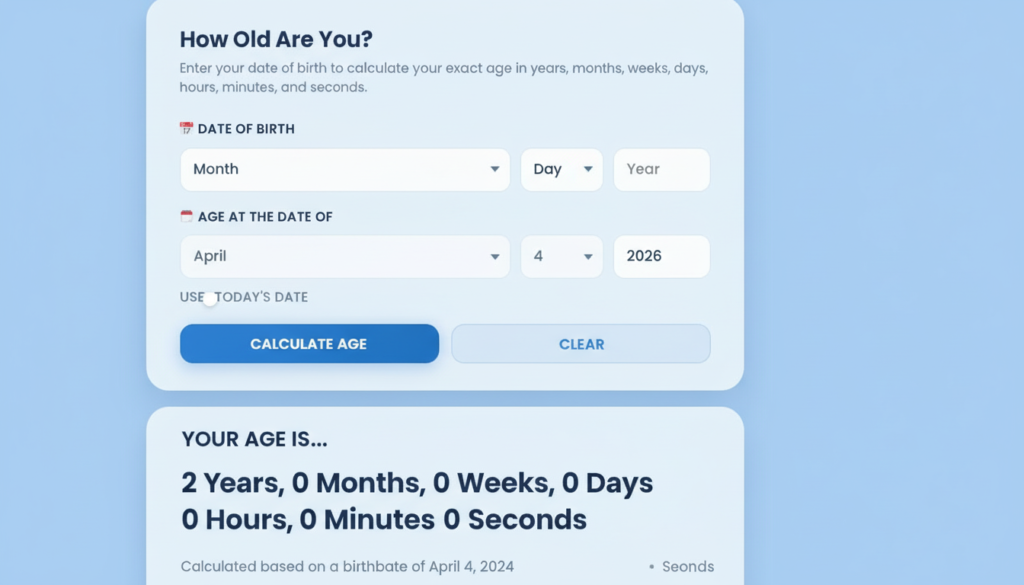
Primary Result (Large Display): Your age is shown prominently as: X Years Old, followed by the month and day breakdown. This is the format used on official documents and in everyday conversation.
Detailed Stats Grid: Below the primary result, a grid shows your age broken down into every major time unit:
- Total months since birth
- Total weeks you have lived
- Total days of your life
- Total hours elapsed since birth
- Total minutes (often running into the millions)
- Total seconds (a staggering number that makes life feel very long and very precious simultaneously)
Birthday Countdown: At the bottom, a countdown shows you exactly how many days remain until your next birthday, the date it falls on, and what age you will be turning.
Step 5 — Clear and Recalculate for Another Date
If you need to calculate for a different person or date, simply click the “Clear” button to reset all input fields to blank. Repeat the process from Step 1.
What the Age Calculator Results Actually Show You
Understanding what each output field means helps you use the tool more effectively and interpret results correctly.
Age in Years, Months, and Days
This is the gold standard format for age representation. It tells you:
- Years: How many complete years have elapsed since your birth
- Months: How many additional complete months have passed beyond those years
- Days: How many additional days beyond the months
Example: If you were born on October 15, 1995, your age on April 4, 2026 would be 30 years, 5 months, and 20 days.
This breakdown is directly applicable to official forms, medical records, passport applications, visa submissions, and any legal document requiring precise age.
Total Weeks, Days, Hours, Minutes, and Seconds
These cumulative totals (not just remainders) are calculated by converting the total day count:
- Total weeks: Total days divided by 7
- Total days: Exact day difference between birth date and target date
- Total hours: Total days × 24
- Total minutes: Total hours × 60
- Total seconds: Total minutes × 60
For a 30-year-old, the numbers are staggering:
- Approximately 1,571 weeks lived
- Roughly 10,997 days on earth
- Over 263,000 hours of life
- Nearly 16 million minutes of existence
- Close to 950 million seconds of being alive
These numbers are exact, not estimated. They’re computed directly from the day-count differential — no rounding, no approximation.
Next Birthday Countdown Feature
One of the most delightful features of a well-designed age calculator is the birthday countdown. This tells you:
- Exact number of days until your next birthday
- The calendar date of your next birthday
- Which birthday it will be (e.g., “You will turn 31”)
If you use the calculator on your actual birthday, quality tools recognize this and display a special celebratory message — a thoughtful touch that makes the experience feel personal.
How Age Is Calculated — The Science and Math Behind It
The Gregorian Calendar and Western Age Reckoning
The Gregorian calendar, introduced in 1582 and now used globally as the international civil standard, is the foundation of all modern age calculations. It defines:
- A common year as 365 days
- A leap year as 366 days (occurs every 4 years, with century-year exceptions)
- Months of varying lengths (28–31 days)
Western age reckoning — used across Europe, the Americas, and most of the world — increments a person’s age on their exact birth anniversary (birthday). Age does not change at the stroke of midnight on January 1st; it changes on the specific day and month you were born, each year.
This contrasts with East Asian age reckoning systems (used traditionally in Korea, China, and Japan), where a person is considered one year old at birth and gains another year on the Lunar New Year. Online calculators almost universally use the Western system unless otherwise specified.
How the Calculator Handles Leap Years
Leap years are one of the biggest sources of manual calculation error. A leap year occurs when:
- The year is divisible by 4 AND
- If divisible by 100, it must also be divisible by 400
So 2000 was a leap year, but 1900 was not. 2024 is a leap year; 2025 is not.
For people born on February 29th (a leap day birthday), the calculator uses a specific convention: in non-leap years, the birthday is recognized on February 28th or March 1st depending on the country’s legal standard. Most online calculators default to February 28th.
For all other birth dates, the tool automatically accounts for leap years when calculating total day counts, ensuring every day is accounted for with no duplication or omission.
Dealing with Uneven Month Lengths and Edge Cases
The most computationally nuanced aspect of age calculation is handling partial months when month lengths differ. Consider someone born on January 31st:
- One month later is technically February 31st — a date that doesn’t exist
- The calculator must decide: is it February 28th (or 29th) or March 1st?
High-quality age calculators use the “same-day-next-month” convention: if the target day doesn’t exist in the target month, the calculation rolls to the last valid day of that month. This ensures consistency and prevents double-counting of days.
According to established principles in computational date arithmetic, this convention is the most widely accepted and legally aligned approach for civil age reckoning, as referenced by institutions including TimeandDate.com’s date calculator documentation, a globally recognized authority on date and time computation.
Who Should Use an Online Age Calculator?
Students and Education Applicants
School enrollment cutoff dates are among the most common use cases for precise age calculation. Many school boards require a child to have reached a specific age by a certain date in the academic year. University entrance exams and scholarship programs similarly use age brackets. A calculation that’s off by even one day can mean the difference between eligibility and a year’s wait.
Parents and Pediatric Caregivers
Pediatricians track developmental milestones by age in months and weeks, not just years. Vaccine schedules, growth chart assessments, and dietary recommendations are all tiered to precise age windows. Parents who know their child’s age in months are better equipped to communicate with healthcare providers and track normal developmental ranges.
HR Professionals and Employers
Human resources departments routinely verify employee ages for retirement benefit calculations, early retirement eligibility, insurance bracket classifications, and statutory leave entitlements. Age-related employment law thresholds require precision — approximate year-based math is not sufficient for compliance purposes.
Medical and Healthcare Professionals
In clinical settings, a patient’s exact age at the time of a procedure, prescription, or diagnosis directly influences treatment protocols. Drug dosages — especially for pediatric patients, elderly patients, and those on weight-sensitive medications — are often calculated using age in years and months. An age calculator is a valuable supporting tool in clinical workflows.
Legal and Financial Planners
Attorneys handling estate planning, probate, guardianship, and powers of attorney work with precise age milestones. Financial advisors calculating pension drawdown schedules, Social Security eligibility windows, and retirement fund access ages need exact date arithmetic — not approximations.
Content Creators and Social Media Enthusiasts
Milestone birthday posts — “I’ve been alive for exactly 10,000 days,” “Today I hit 1 billion seconds” — generate enormous social media engagement. Content creators, influencers, and everyday users who love meaningful personal statistics use age calculators to find these milestones and build compelling content around them. Just like our Word Counter Tool helps creators track their content length accurately, the Age Calculator helps them discover engaging personal milestones instantly.
Age Calculator vs. Other Methods — A Full Comparison
Manual Subtraction
How it works: Current year minus birth year. Accuracy: Year-level only, frequently off by one due to pre-birthday timing. Effort: Instant, but unreliable. Best for: Casual conversation only.
Spreadsheet Formulas (Excel/Google Sheets)
How it works: DATEDIF() or YEARFRAC() functions in Excel or Google Sheets. Accuracy: Good for years and months with proper formula setup. Effort: Requires spreadsheet knowledge; formula errors are common. Best for: Power users comfortable with spreadsheet syntax.
Online Age Calculator Tools
How it works: Automated computation via browser-based tool, zero user input beyond the dates. Accuracy: Years, months, days, weeks, hours, minutes, seconds — full precision. Effort: Minimal — two date inputs and one button click. Best for: Everyone, for any purpose, instantly.
| Method | Time Unit Accuracy | Leap Year Handling | Ease of Use | Speed |
|---|---|---|---|---|
| Mental subtraction | Year only | ❌ None | ⭐⭐⭐⭐⭐ | Instant |
| Excel DATEDIF | Year + Month | ✅ Partial | ⭐⭐⭐ | Medium |
| Google Sheets formula | Year + Month | ✅ Partial | ⭐⭐⭐ | Medium |
| Online Age Calculator | All units | ✅ Complete | ⭐⭐⭐⭐⭐ | Instant |
The verdict is clear: for any purpose that goes beyond casual estimation, a dedicated online age calculator is the fastest, most accurate, and most accessible solution available — and it costs nothing.
Common Questions About Age Calculation (LSI and NLP Coverage)
Can I calculate the age for Someone Else?
Absolutely. The tool does not require any login or personal identification. Simply enter any person’s date of birth — a family member, a colleague, a historical figure, or even a public figure whose birth date is known. The calculation works identically regardless of whose date is entered.
Can I Find My Age on a Specific Past or Future Date?
Yes. Toggle off the “Use today’s date” setting and manually enter any target date you wish. This is useful for:
- Determining your age at the time of a past event (“How old was I when I graduated in 2015?”)
- Confirming future eligibility (“Will I be 65 by December 31, 2026?”)
- Historical or genealogical research (“How old was my grandfather when he emigrated?”)
How Accurate Is the Calculator for Old or Historical Birth Dates?
Most well-built age calculators accurately handle birth dates from 1900 onward, encompassing all leap years within that period. For dates before 1900, minor inaccuracies may arise due to historical calendar reforms (particularly the transition from the Julian to Gregorian calendar in various countries at different times). For post-1900 dates — which cover virtually all living individuals — accuracy is complete and reliable.
Does an Age Calculator Work on Mobile Devices?
Yes. Quality online age calculators are built with responsive design — a web development standard that ensures the interface adapts fluidly to all screen sizes, from large desktop monitors to tablets and smartphones. The FastTaskTools Age Calculator is fully mobile-optimized and requires no app download or installation.
Is My Personal Data Safe When Using an Online Age Calculator?
Reputable online age calculators perform all computations client-side — meaning the calculation happens entirely within your browser using JavaScript, and no data is transmitted to or stored on any external server. Your date of birth never leaves your device. Always verify this is the case for any tool you use; legitimate tools will confirm this in their privacy policy.
LSI Keywords, NLP Terms, and Related Topics Covered
This guide intentionally incorporates the following semantically related terms, LSI (Latent Semantic Indexing) keywords, and NLP-adjacent concepts to provide complete topical coverage:
Primary Keywords: age calculator online, how to use age calculator, calculate age from date of birth, exact age calculator, date of birth calculator
LSI Keywords: how old am I, age in days calculator, age in years months days, birthday calculator, find my age, age counter, birth date calculator, chronological age calculator, age by date, days alive calculator
NLP Entity Terms: date of birth (DOB), Gregorian calendar, leap year, Western age reckoning, chronological age, biological age, calendar date arithmetic, birth anniversary, target date, partial month calculation
Intent-Matching Topics: how to calculate exact age, age calculation formula, how age is calculated with leap years, what is my age in days, age calculator for legal documents, calculate age for school enrollment, how many days have I been alive, age in seconds calculator, birthday countdown tool, how to find age from date of birth
Tips to Get the Most Out of Your Age Calculator
- Double-check your birth year: A single digit error in the year produces wildly incorrect results. Always verify before clicking calculate.
- Use the target date feature for planning: Don’t just check your current age — use the custom date feature to determine future eligibility dates for pensions, licenses, exams, or programs.
- Screenshot your milestone stats: When the calculator reveals that you’ve lived exactly 10,000 days or 30 years to the date, screenshot the result card and share it — these make for uniquely personal social media posts.
- Use it for family health records: Keep track of your children’s exact ages in months for pediatric appointments by running a quick calculation before each visit.
- Bookmark the tool: An age calculator isn’t a one-time tool. Whether it’s for paperwork, planning, or personal milestones, having the link saved means you can return in seconds whenever needed.
- Use the birthday countdown as a reminder: The countdown to your next birthday gives you a specific number of days — enough to use as a countdown for planning a celebration or a meaningful goal.
Frequently Asked Questions (FAQ)
Q: What is the most accurate way to calculate age online? A: Using a dedicated online age calculator that accounts for leap years, uneven month lengths, and partial months — and that computes results in years, months, and days rather than years alone.
Q: What does “age in months” mean? A: Age in months refers to the total number of complete calendar months elapsed since birth. This measure is especially important in pediatric healthcare, where developmental milestones are tracked monthly for children under two years of age.
Q: What is a date of birth calculator? A: A date of birth calculator is another name for an age calculator — a tool that takes your birth date as input and outputs your precise age. The terms are interchangeable.
Q: What is chronological age? A: Chronological age is the objective measure of time elapsed since a person’s birth date. It is the legal and medical standard for age, calculated in years, months, and days using the Gregorian calendar.
Q: How do I know how many days old I am? A: Enter your date of birth into an online age calculator and look at the “Total Days” figure in the detailed stats section. This number represents every single day you have been alive, including leap year days.
Q: Can an age calculator determine if I’m eligible for something? A: An age calculator can tell you your precise age on any given date. Whether that meets a specific eligibility threshold depends on the rules of the program, institution, or law in question — but the calculator gives you the exact age data you need to make that determination.
Start calculating your exact age today using the free Age Calculator from FastTaskTools — no login, no download, no cost. Just enter your date of birth and discover the full story of your time on this planet, down to the very last second.