Summary: Whether you are just launching your freelance career or scaling a well-established independent business, having the right digital toolkit is the single biggest lever for your productivity, professionalism, and profitability. This guide covers every category of freelancer tools in 2026 — from project management and client communication to invoicing, cybersecurity, and AI-powered productivity — giving you a definitive, research-backed resource to build a workflow that wins clients, saves time, and keeps your income growing.
Outline
- Best Tools for Freelancers (2026 List): The Ultimate Guide to Running a Thriving Independent Career
- Why the Right Freelancer Toolkit Matters More Than Ever in 2026
- Project Management and Task Organization Tools for Freelancers
- Best Communication and Client Collaboration Tools
- Top Invoicing, Billing, and Financial Management Tools
- Best Time Tracking Tools for Freelancers
- AI-Powered Productivity Tools Transforming Freelance Work in 2026
- Best Tools for Freelance File Sharing and Storage
- Contracts, Proposals, and E-Signature Tools
- Best Tools for Freelance Marketing and Personal Branding
- Cybersecurity and Privacy Tools Every Freelancer Needs
- Best Freelance Platforms to Find Clients in 2026
- How to Build Your Optimal Freelancer Tech Stack in 2026
- Frequently Asked Questions About Freelancer Tools
Why the Right Freelancer Toolkit Matters More Than Ever in 2026

The global freelance economy has undergone a seismic shift. With over 1.57 billion freelancers worldwide and remote work now a permanent fixture for millions of professionals, the competition for high-value clients has never been more intense. What separates a freelancer earning $50/hour from one earning $200/hour is rarely raw talent — it is systems, professionalism, and efficiency.
The right freelance tools eliminate administrative drag, automate repetitive tasks, reduce client miscommunication, and help you present yourself as a serious business rather than a side-hustle operator. In 2026, AI integration, cloud-native workflows, and async-first communication have redefined what a productive freelancer stack looks like.
Key NLP-related concepts and LSI keywords woven throughout this guide include: independent contractor software, remote work tools, self-employed productivity apps, freelance business management, client management tools, best apps for solopreneurs, digital nomad toolkit, work-from-home software, gig economy tools, and online collaboration platforms.
This guide is organized by category so you can jump to exactly what you need — or read from top to bottom to architect your entire system from scratch.
Project Management and Task Organization Tools for Freelancers
Managing multiple client projects simultaneously without a clear system leads to missed deadlines, scope creep, and burnout. Project management tools give freelancers the operational backbone of a small agency without the overhead.
Notion – The All-in-One Freelance Workspace
Notion has become the gold standard for freelancers who want one tool to rule them all. It functions simultaneously as a project tracker, client CRM, knowledge base, content calendar, and personal journal. Its flexibility means you can build a custom dashboard tailored to your specific freelance niche — whether you are a UX designer, content strategist, or web developer.
Key features for freelancers:
- Client portals built from shared databases
- Project timelines with Kanban, calendar, and list views
- Template gallery with ready-made freelance workflows
- Notion AI integration for drafting briefs, summarizing notes, and generating task lists
Best for: Freelancers who manage 3+ active clients and need a centralized command center.
Pricing: Free plan available; Plus plan at $10/month.
Trello vs. Asana – Which is Better for Solo Freelancers?
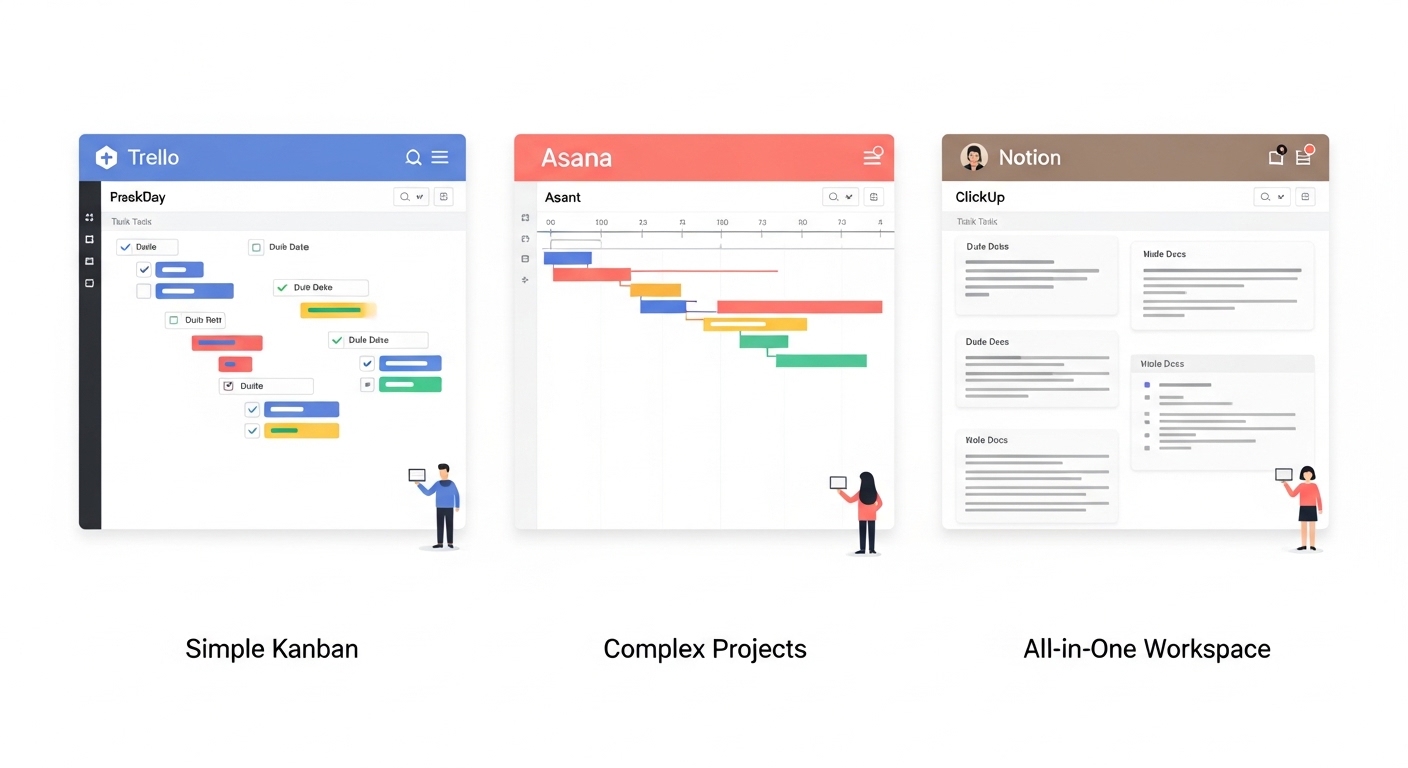
Trello’s card-based Kanban system is visually intuitive and excellent for freelancers managing simple, linear workflows. Its drag-and-drop interface requires zero onboarding, and the free tier is remarkably generous for solos.
Asana, on the other hand, is better suited to freelancers who manage complex deliverables with multiple dependencies, subtasks, and client-facing timelines. Its Timeline view and reporting features make it easier to communicate project status to clients.
Verdict: Use Trello if you are a solo freelancer with straightforward workflows. Upgrade to Asana if you collaborate with subcontractors or manage projects with multiple moving parts.
ClickUp – The Power User’s Project Hub
ClickUp is the most feature-dense project management tool available for freelancers in 2026. It combines task management, docs, goals, time tracking, and even a basic CRM into one platform. The learning curve is steeper than Trello or Notion, but for freelancers serious about operational efficiency, ClickUp’s automation engine is transformative — automating task creation, status updates, and client notifications without lifting a finger.
Best Communication and Client Collaboration Tools
Client communication is one of the most underrated skills in freelancing. Over-communicating creates friction; under-communicating erodes trust. The right tools help you strike the perfect balance.
Slack for Freelancers – Keeping Client Communication Clean
Many enterprise clients already use Slack internally and will invite freelancers to their workspace. Setting up your own Slack workspace for smaller clients signals professionalism and keeps project conversations cleanly separated from email threads. With Slack’s Connect feature, you can bridge multiple client workspaces from a single dashboard.
Pro tip: Create dedicated channels for each client project (#project-name-updates, #project-name-assets) to maintain organized, searchable communication histories.
Zoom and Loom – Async vs. Sync Communication
Zoom remains the default tool for synchronous client video calls, discovery sessions, and project kick-offs. However, Loom has become an indispensable async communication tool — allowing freelancers to record short screen-share videos explaining deliverables, walking through revisions, or responding to client questions without scheduling a live call.
Loom videos dramatically reduce back-and-forth email chains and demonstrate a level of client care that builds long-term loyalty. For international clients across multiple time zones, asynchronous video communication is often more effective than trying to schedule overlapping hours.
Calendly – Automating Discovery Calls and Meetings
Calendly eliminates the scheduling dance entirely. Share your booking link, set your availability windows, and let clients book directly into your calendar. In 2026, Calendly integrates natively with Zoom, Google Meet, HubSpot, Stripe (for paid consultations), and dozens of other tools in the freelancer stack.
Pricing: Free tier available; Standard plan at $10/month with payment collection features.
Top Invoicing, Billing, and Financial Management Tools
Getting paid on time — and in full — is the most critical operational challenge for any freelancer. A professional invoicing system signals that you run a real business, sets clear payment expectations, and reduces the cognitive overhead of chasing payments.
FreshBooks – Best All-Round Invoicing Platform for Freelancers
FreshBooks was built specifically for self-employed professionals and small service businesses. Its invoicing engine is elegant, fast, and deeply functional — supporting recurring invoices, automatic late payment reminders, time-tracked billing, expense tracking, and client retainer management. Its reporting suite gives you a clear view of cash flow, outstanding invoices, and profitability by client.
Key features:
- Automated invoice reminders reduce late payments by up to 30%
- Accept payments via Stripe, PayPal, and ACH bank transfer
- Built-in double-entry accounting for tax season
- Mobile app for invoicing on the go
Best for: Freelancers billing $3,000+/month who need a complete accounting ecosystem.
Wave – The Free Financial Tool That Punches Above Its Weight
Wave offers unlimited invoicing, expense tracking, and financial reporting completely free. It monetizes through payment processing fees (2.9% + $0.60 per credit card transaction). For freelancers just starting out or those who prefer simple, no-subscription tools, Wave delivers exceptional value.
Limitations: Wave’s feature set has not kept pace with FreshBooks in areas like time tracking, project profitability reporting, or client portal functionality. But for straightforward invoicing and bookkeeping, it remains one of the best free tools for freelancers.
QuickBooks Self-Employed – For Freelancers Who Think Like a Business
QuickBooks Self-Employed is the go-to tool for freelancers who want seamless tax preparation integration. It automatically categorizes business vs. personal expenses, estimates quarterly tax payments, and exports directly to TurboTax. If tax complexity is your primary financial pain point, QuickBooks Self-Employed is worth its subscription price several times over.
Best Time Tracking Tools for Freelancers
Time tracking serves two purposes: it ensures you bill clients accurately for hourly work, and it reveals how you actually spend your working hours — often exposing hidden inefficiencies in your workflow.
Toggl Track – Simple, Reliable, and Free
Toggl Track is the most beloved time tracking app in the freelance community for good reason. Its one-click timer, browser extension, desktop app, and mobile app make capturing time virtually frictionless. Reports are clean and exportable. The free plan supports unlimited projects and clients — genuinely enough for most freelancers.
Harvest – Time Tracking With Built-In Invoicing
Harvest bridges the gap between time tracking and invoicing by allowing you to convert tracked time directly into client invoices with a single click. This integration eliminates manual data transfer and reduces billing errors. Harvest also integrates with Asana, Basecamp, Trello, and dozens of other project management tools.
Best for: Hourly freelancers who want a tighter link between tracked time and billing.
Clockify – The Zero-Cost Option for Hourly Freelancers
Clockify offers unlimited time tracking, unlimited projects, and unlimited users on its free plan — making it the most generous free option in the category. For freelancers who work with subcontractors and need a shared time tracking system without the per-seat cost, Clockify is unmatched.
AI-Powered Productivity Tools Transforming Freelance Work in 2026
Artificial intelligence has fundamentally changed the productivity ceiling available to independent workers. In 2026, AI tools are not optional extras — they are the competitive differentiator between freelancers who scale and those who plateau.
Claude and ChatGPT – AI Writing and Ideation Assistants
Both Claude (by Anthropic) and ChatGPT (by OpenAI) have become central to how freelancers research, draft, edit, and ideate. For writers, they accelerate first drafts. For developers, they generate boilerplate code. For consultants, they synthesize research and structure presentations.
The key to leveraging AI assistants effectively is prompt engineering — crafting specific, context-rich prompts that yield usable outputs rather than generic text that requires heavy rewriting. Freelancers who master prompt engineering can realistically double or triple their output without sacrificing quality.
Jasper AI – Purpose-Built for Freelance Copywriters
Jasper AI is specifically trained on marketing and copywriting data, making it better suited than general AI models for freelancers working in content marketing, ad copy, email sequences, and SEO writing. Its Brand Voice feature allows you to train the AI on a client’s tone and style guidelines, producing outputs that require minimal editing.
Otter.ai – Transcribing Client Calls in Real Time
Otter.ai automatically transcribes audio from Zoom, Google Meet, and Microsoft Teams calls in real time. Post-meeting, you can review a searchable transcript, extract action items, and send meeting summaries to clients — all from a single interface. This eliminates the note-taking burden during calls and creates a clear paper trail of client decisions and feedback.
Best Tools for Freelance File Sharing and Storage
Delivering work to clients professionally — and securely — requires a reliable file sharing and storage infrastructure. Disorganized file delivery is one of the most common reasons clients perceive freelancers as unprofessional.
Google Drive and Dropbox – The Classic Duo
Google Drive remains the default for text-heavy deliverables, collaborative documents, and spreadsheets. Its commenting and suggestion features make client review cycles seamless. Dropbox, while slightly reduced in market share since its peak years, remains preferred for large media files, design assets, and video deliverables due to its superior sync reliability and version history depth.
Organization tip: Create a standardized folder structure for every client — /Client Name/Project Name/Drafts, /Deliverables, /Assets, /Contracts — and replicate it consistently. This habit alone sets you apart from 80% of freelancers.
Safe and Secure File Sharing for Sensitive Client Deliverables
When working with enterprise clients, legal documents, financial data, or confidential business information, standard consumer cloud storage is insufficient. Freelancers handling sensitive deliverables should explore purpose-built secure sharing solutions. For a detailed overview of encrypted and access-controlled platforms, check out this comprehensive guide to the best tools for safe file sharing online — particularly valuable if your client base includes healthcare, legal, or fintech companies where data compliance is non-negotiable.
Contracts, Proposals, and E-Signature Tools
A signed contract is the single most important protection a freelancer has. It defines scope, sets payment terms, establishes revision limits, and provides legal recourse if a client relationship goes sideways. The tools in this category make the contract and proposal process fast enough that no freelancer has an excuse to skip it.
Bonsai – The Freelancer’s Legal Swiss Army Knife
Bonsai was built exclusively for freelancers, and it shows. Its contract templates are legally vetted, customizable, and cover the most common freelance scenarios — project-based work, retainers, consulting agreements, and subcontractor arrangements. Beyond contracts, Bonsai includes proposals, invoicing, time tracking, and a basic CRM — making it a compelling all-in-one solution for freelancers who want to minimize the number of tools in their stack.
Pricing: Starter plan from $17/month.
DocuSign vs. HelloSign – E-Signature Showdown
DocuSign is the enterprise standard for e-signatures and is instantly recognizable to corporate clients. HelloSign (now rebranded as Dropbox Sign) offers a cleaner, more affordable experience for freelancers. If your clients are primarily enterprise or corporate, DocuSign’s brand recognition adds credibility. If you work with startups and small businesses, Dropbox Sign is equally legally valid at a fraction of the price.
PandaDoc – For High-Value Proposals
PandaDoc is the most polished proposal tool in the market. Its drag-and-drop proposal builder, e-signature integration, proposal analytics (you’ll know exactly when a client opens and reads your proposal), and payment collection make it the weapon of choice for freelancers pitching high-value retainers and long-term engagements. According to PandaDoc’s own data, proposals with embedded videos have a significantly higher close rate than text-only documents.
Best Tools for Freelance Marketing and Personal Branding
Inbound marketing — attracting clients to you rather than chasing them — is the most scalable growth strategy for a freelance business. The tools below help you build a personal brand that generates a steady stream of warm leads.
LinkedIn Premium – Building Authority in Your Niche
LinkedIn remains the highest-ROI social platform for B2B freelancers in 2026. LinkedIn Premium’s InMail credits, profile analytics, and “Open to Work” visibility features give you an edge in discoverability. More importantly, consistent content publishing — case studies, industry insights, client wins — builds the kind of social proof that makes prospects reach out to you.
Canva Pro – Visual Branding Without a Designer
Canva Pro’s Brand Kit feature allows freelancers to store brand colors, fonts, and logos and apply them across all visual assets — social posts, proposals, media kits, presentations, and invoices — with one click. For non-designers, it is the most accessible path to professional visual consistency.
Key 2026 upgrade: Canva’s AI design features can now generate on-brand social graphics, presentation layouts, and marketing materials from text prompts — dramatically reducing the time investment in visual content creation.
Beehiiv and ConvertKit – Email Marketing for Freelancers
Building an email list is the most resilient long-term marketing asset a freelancer can own. Unlike social media followers, your email subscribers belong to you regardless of platform algorithm changes. Beehiiv has emerged as the platform of choice for freelancers building newsletter-based personal brands, while ConvertKit (now rebranded as Kit) remains the standard for freelancers using email automation to nurture leads through longer sales cycles.
Cybersecurity and Privacy Tools Every Freelancer Needs

Cybersecurity is the most overlooked category in most freelancer tool guides. Yet data breaches, phishing attacks, and compromised client credentials represent a genuine business and legal risk for independent workers.
VPN Services – Protecting Client Data on Public Networks
Freelancers who work from coffee shops, co-working spaces, and airports are especially vulnerable to man-in-the-middle attacks on unsecured public Wi-Fi. A reliable VPN encrypts your internet connection, masks your IP address, and prevents eavesdropping on sensitive client communications. Top-rated options in 2026 include NordVPN, ExpressVPN, and Mullvad — each offering strong no-logs policies and fast connection speeds.
Password Managers – LastPass, 1Password, and Bitwarden
Reusing passwords across client platforms, SaaS tools, and financial accounts is one of the highest-risk security behaviors a freelancer can engage in. A password manager generates, stores, and auto-fills unique, complex passwords for every account. 1Password is widely considered the best combination of security and usability. Bitwarden is the open-source alternative with a compelling free tier. Both offer team sharing features useful for freelancers who delegate tasks to virtual assistants.
Best Freelance Platforms to Find Clients in 2026
No tool guide would be complete without addressing where freelancers actually find work. While referrals and inbound marketing are the most sustainable long-term channels, platforms still represent the fastest path to early-stage client acquisition.
Upwork and Fiverr – Mass Market Marketplaces
Upwork’s hourly and fixed-price contract system, escrow payment protection, and client review ecosystem make it the most trusted mass-market platform for freelancers in 2026. Its AI-powered job matching has improved significantly, surfacing more relevant opportunities based on your profile and work history.
Fiverr is structured around productized services (called “gigs”) and attracts clients who know exactly what they want and want to buy it quickly. The platform is ideal for freelancers with clearly packaged offerings — logo design, SEO audits, video editing, social media management — rather than bespoke consulting.
Toptal and Contra – Premium Freelance Networks
Toptal’s rigorous vetting process (accepting roughly the top 3% of applicants) positions accepted freelancers as elite talent and commands significantly higher rates. The platform’s client base includes Fortune 500 companies, funded startups, and investment firms.
Contra is a newer, community-driven platform that has gained significant traction among creative and technical freelancers who want to build a public portfolio, connect with other independent workers, and take commissions from the platform at lower rates than Upwork.
How to Build Your Optimal Freelancer Tech Stack in 2026
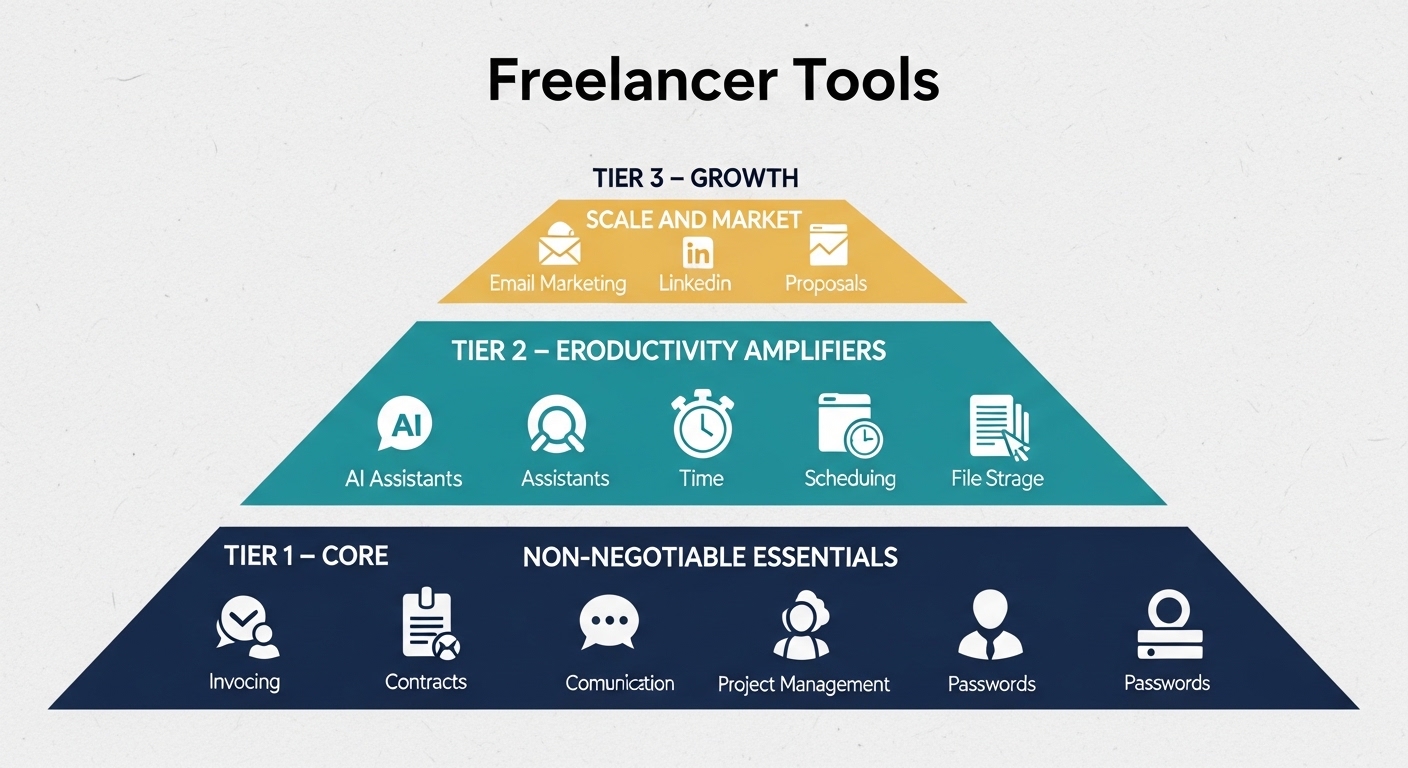
The best tech stack is the one you actually use. The most common mistake freelancers make is over-tooling — subscribing to every promising app until the tools themselves become an administrative burden. Here is a pragmatic framework for building your stack:
Tier 1 – Non-Negotiable Core (Every Freelancer): Start with one project management tool (Notion or Trello), one invoicing tool (FreshBooks or Wave), one communication tool (Slack or email), one e-signature tool (Bonsai or Dropbox Sign), and one password manager (1Password or Bitwarden). These five categories form the operational spine of any freelance business.
Tier 2 – Efficiency Layer (For Growing Freelancers): Once your core is stable, add time tracking (Toggl), scheduling automation (Calendly), file storage organization (Google Drive), and one AI assistant (Claude or ChatGPT). These tools amplify your output without adding significant complexity.
Tier 3 – Growth and Scale (For Established Freelancers): When you are generating consistent revenue and looking to grow, invest in marketing tools: a personal website (Webflow or Framer), email marketing (ConvertKit), LinkedIn Premium, and a proposal tool (PandaDoc). These tools compound over time, building the inbound pipeline that makes your business truly scalable.
Total monthly cost benchmarks: A lean, functional stack for a new freelancer can cost as little as $0–$30/month using free tiers. A fully optimized stack for an established freelancer typically runs $150–$300/month — an investment that should generate multiples in recovered time, reduced administrative drag, and won client work.
Frequently Asked Questions About Freelancer Tools
What is the single most important tool for a new freelancer? An invoicing and payment tool. Getting paid reliably is the operational foundation of any freelance business. FreshBooks or Wave should be set up before you take your first client.
Do freelancers really need project management software? Yes, once you have more than two active clients simultaneously. Without a system, tasks fall through the cracks, deadlines are missed, and client trust erodes. Even a simple Trello board transforms your ability to manage multiple workstreams.
Are AI tools worth it for freelancers? Absolutely. In 2026, AI tools are not about replacing freelancers — they are about multiplying their capacity. A freelance writer who uses AI for research and drafting can deliver 2–3x more work in the same hours. This either increases income or frees time for marketing, upskilling, and rest.
What tools do successful six-figure freelancers use? The most consistent patterns among high-earning freelancers include: a professional invoicing system with automated reminders, a signed contract for every engagement, a CRM or client tracking system, a content-based marketing channel (newsletter, LinkedIn, or podcast), and a productized service offering that reduces custom scoping for every client.
How do I protect client data as a freelancer? Use a VPN on public networks, store client files in encrypted cloud storage, use a password manager for all platform credentials, and have a clear data handling policy in your contracts. For clients in regulated industries, consider purpose-built secure file sharing tools and review your obligations under GDPR, HIPAA, or other applicable frameworks.
Last updated: April 2026. Tool pricing and features are subject to change — always verify current plans on each platform’s official website before subscribing.