

Summary
Managing daily tasks without apps is not only possible — it is, for many people, more effective, more sustainable, and more mentally freeing than relying on digital tools. This comprehensive guide explores every proven method, framework, and habit for offline task management, from the timeless bullet journal system and paper planners to the Ivy Lee Method, time blocking on paper, and the power of the simple to-do list. Whether you are trying to reduce screen time, overcome digital overwhelm, improve focus, or build lasting productivity habits, analog task management gives you full control over your day without notifications, subscriptions, or battery anxiety.
Outline
- How to Manage Daily Tasks Without Apps: The Complete Guide to Analog Productivity
- Why Managing Daily Tasks Without Apps Works
- Core Principles of Effective Offline Task Management
- The Best Tools for Managing Tasks Without Apps
- Proven Methods and Systems for App-Free Task Management
- How to Build a Paper-Based Productivity System Step by Step
- Managing Work Tasks Without Apps
- Managing Personal and Home Tasks Without Apps
- Overcoming Common Challenges of Going App-Free
- Tips, Habits, and LSI-Rich Best Practices
Why Managing Daily Tasks Without Apps Works
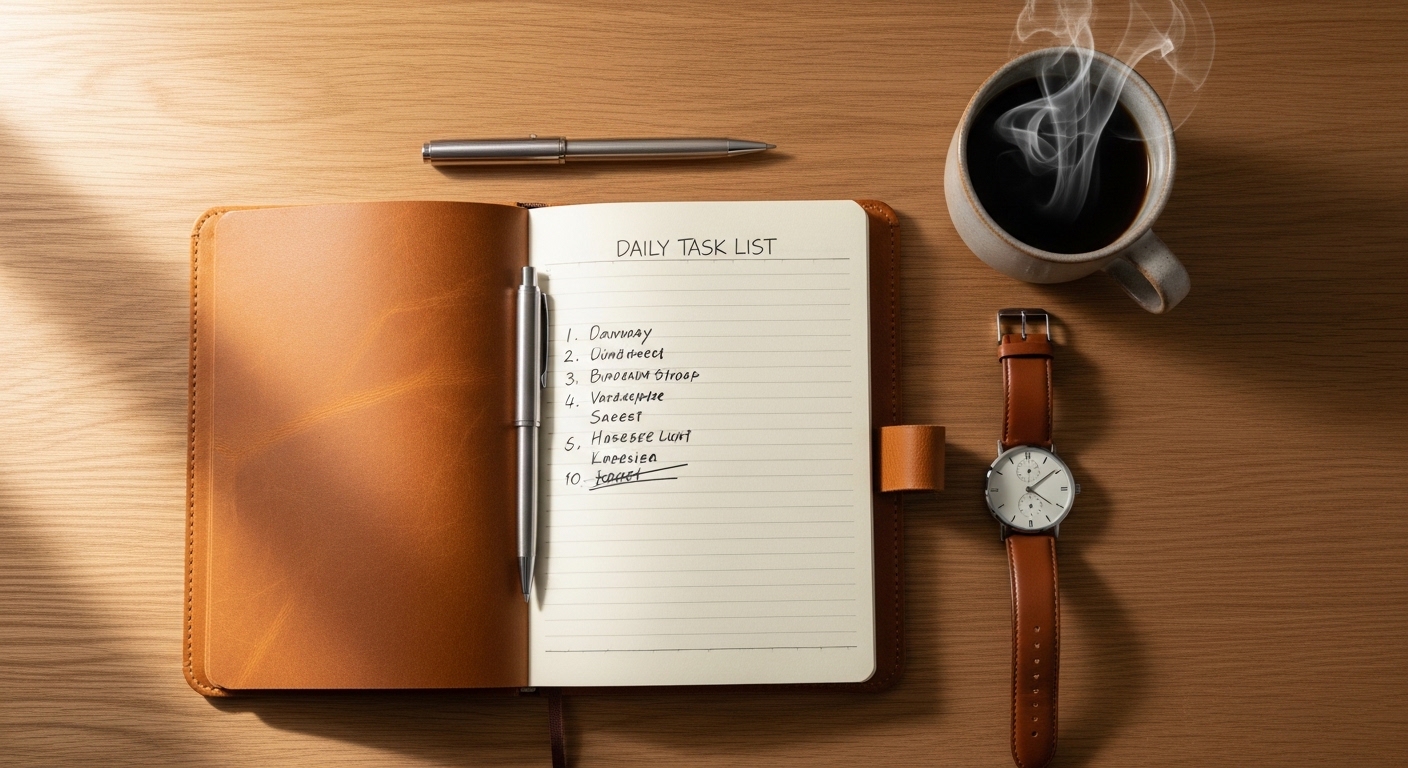
In a world saturated with productivity applications, browser extensions, and notification-driven task managers, the idea of managing your daily tasks without apps might sound counterproductive. Yet thousands of people — professionals, students, creatives, and entrepreneurs — are rediscovering the profound simplicity and effectiveness of offline, analog task management.
The core argument is not that technology is bad. The tool should serve the person, not the other way around. When your task system lives entirely on a screen, it competes for attention with every other notification, tab, and distraction that screen offers. When it lives on paper, it exists in a quieter, more intentional space.
The Psychology Behind Analog Productivity
Neuroscience and cognitive psychology give us compelling reasons to trust paper. Research into the encoding specificity principle suggests that writing by hand engages deeper cognitive processing than typing. When you physically write down a task, your brain processes it more thoroughly — which means better recall, clearer thinking, and stronger commitment to follow-through.
Additionally, the act of crossing off a completed task on paper activates a tangible sense of accomplishment. There is a visceral reward in drawing a line through a written item that no digital checkmark fully replicates. This connects to the Zeigarnik effect — the psychological tendency to remember incomplete tasks more vividly than completed ones — which paper-based systems leverage by making completion physically visible.
The paper also removes the decision fatigue that many digital apps introduce. When you open a task app, you are often confronted with sorting options, tags, filters, priority flags, and integration menus. A notebook simply asks: What are you going to do today?
Digital Fatigue and the Case for Going Screen-Free
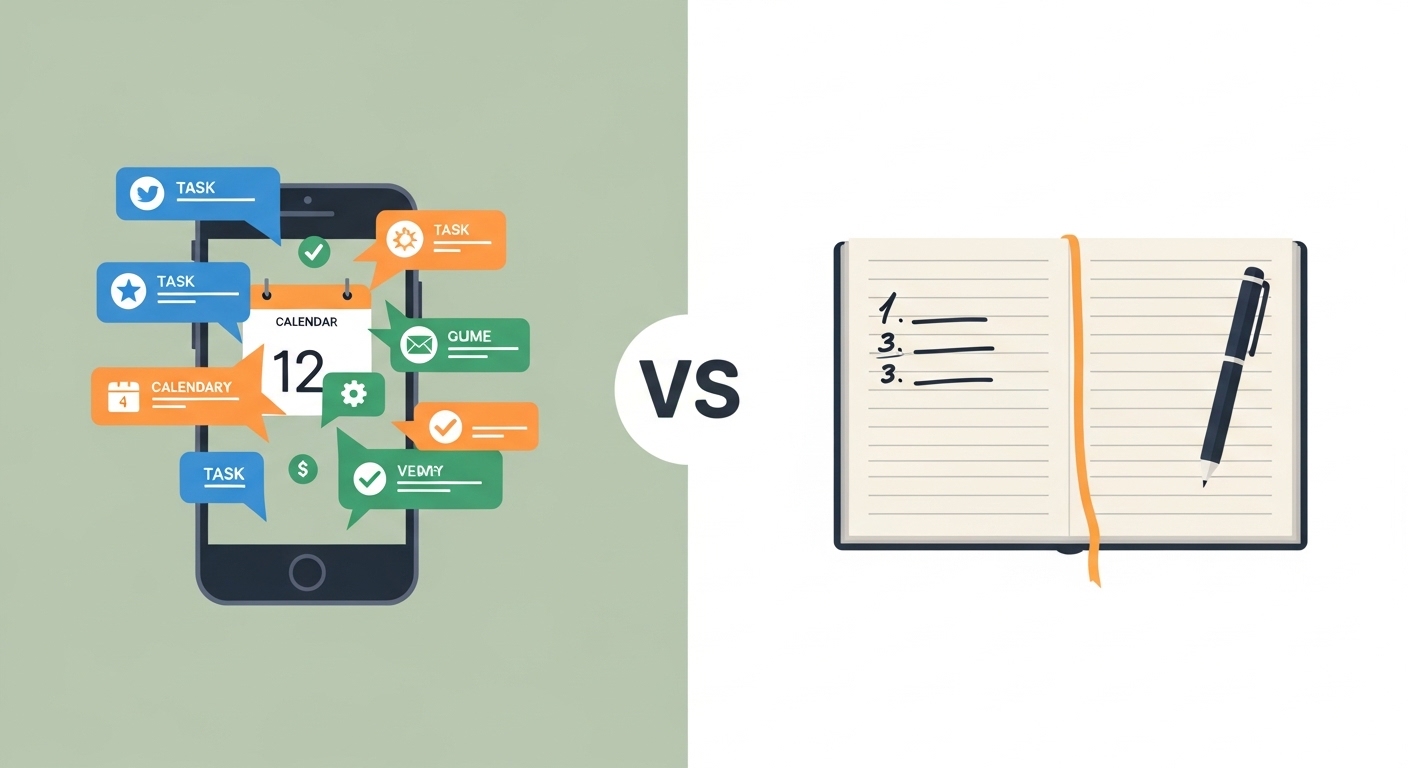
The average knowledge worker spends over seven hours per day looking at a screen. Adding task management to that screen time means your productivity system is part of the same environment that hosts your distractions. Notifications from a task app are still notifications — and each one fractures your focus.
Going screen-free for your task management addresses what productivity researchers call continuous partial attention: the state of perpetually scanning for incoming information rather than deeply engaging with the task at hand. A paper planner cannot ping you. It cannot auto-reschedule your meeting. It requires you to engage with it intentionally, which is precisely the habit that separates high-performers from overwhelmed multitaskers.
Who Benefits Most from App-Free Task Management
Analog task management is especially effective for:
- People with ADHD or attention difficulties, who benefit from tactile engagement and reduced screen stimulation
- Creative professionals, who think better when they write freely without the constraints of a structured interface
- Executives and managers, who process decisions better when they slow down to write rather than tap
- Students who retain information better when they handwrite notes and to-do lists
- Anyone experiencing burnout who needs a break from the digital loop of work, notifications, and dopamine cycles
- Minimalists and digital detox practitioners, who are intentionally reducing screen dependency
Core Principles of Effective Offline Task Management
Before choosing a specific system or tool, it is important to understand the principles that make any task management approach work — with or without technology.
Clarity — Knowing What Needs to Be Done
The single biggest failure in any task system, digital or analog, is vagueness. “Work on the project” is not a task. “Write the introduction paragraph for the Henderson report” is a task. Clarity means every item on your list is specific, actionable, and complete in a defined session.
When building your offline task system, train yourself to never write a vague intention. Ask: What does “done” look like? If you cannot answer that, the item is a goal or a project, not a task, and it needs to be broken down further.
Priority — Deciding What Matters Most
Without an algorithm to surface your most important items, priority management becomes a conscious daily practice. This is actually an advantage. When you are forced to manually decide which three tasks matter most today, you develop a clearer sense of your values, deadlines, and long-term direction.
Prioritization in analog systems is done through numbering, starring, color coding, or explicit ranking — all discussed in detail below. The key principle: every day must have a clear top priority, not a list of ten equally-weighted items.
Consistency — Building a Daily Routine Without Technology
Analog systems live or die by the habit of using them. Unlike an app that sends you reminders, a paper planner requires you to choose to open it every day. This means your success depends on embedding your planning ritual into an existing routine — morning coffee, the commute, or end-of-day wind-down.
James Clear, in his work on habit formation, describes habit stacking — attaching a new behavior to an existing one. Pair your daily planning with something you already do without thinking, and the paper planner becomes automatic.
The Best Tools for Managing Tasks Without Apps
The analog productivity toolkit is surprisingly rich. Choosing the right physical tools for your personality and workflow makes the difference between a system you love and one you abandon after a week.
Paper Planners and Daily Planners
A structured daily planner provides pre-printed frameworks — time grids, priority boxes, habit trackers, and daily intention prompts. Popular options include undated planners (which let you start any time) and dated planners (which create a sense of forward momentum).
The best paper planners for task management typically include:
- A space for the day’s top three priorities
- An hourly or half-hourly time grid
- A notes or brain dump section
- A habit or routine tracker
Well-regarded physical planners used by productivity-focused individuals include the Full Focus Planner, Panda Planner, and the classic Moleskine weekly notebook.
Notebooks and Bullet Journaling
The Bullet Journal (BuJo), developed by designer Ryder Carroll, is one of the most flexible and widely adopted analog productivity systems in the world. At its core, it uses a simple, rapid logging notation system:
- · (dot) = task
- × (cross) = completed task
- > (arrow) = migrated task (moved to another day)
- – (dash) = note
- ○ (circle) = event
The Bullet Journal also uses Collections — themed spreads like a monthly log, future log, habit tracker, and project pages — all housed in a single notebook. The system is infinitely customizable and works in any blank or dotted notebook.
For those who want to learn more about analog productivity and how it intersects with mathematical and structured thinking, understanding how to calculate percentages can also support task-tracking habits like measuring completion rates and weekly progress without any digital tools.
Index Cards and the Hipster PDA (hPDA)
The Hipster PDA, coined by blogger Merlin Mann in the early 2000s, is a stack of index cards held together by a binder clip. It is laughably simple and surprisingly effective. Each card holds one task, project, or reference item. Cards can be reordered, discarded, or archived physically.
Index cards are particularly effective for the card-per-task method: write one task per card, arrange them in order of priority, work through them one at a time, and discard each card when done. The physical act of throwing away a completed task card is deeply satisfying.
Whiteboards and Wall Calendars
For visual thinkers and household or team task management, a whiteboard or large wall calendar offers a bird’s-eye view of the week or month. Tasks can be written in columns by day, erased and moved as priorities shift, and viewed at a glance without any interface navigation.
A whiteboard works particularly well for Kanban-style task management — dividing the board into “To Do,” “In Progress,” and “Done” columns, and physically moving sticky notes or written items across columns as work progresses. This method, drawn from Lean manufacturing principles, is highly effective even without a digital tool like Trello or Asana.
Proven Methods and Systems for App-Free Task Management
The Classic To-Do List (and How to Do It Right)
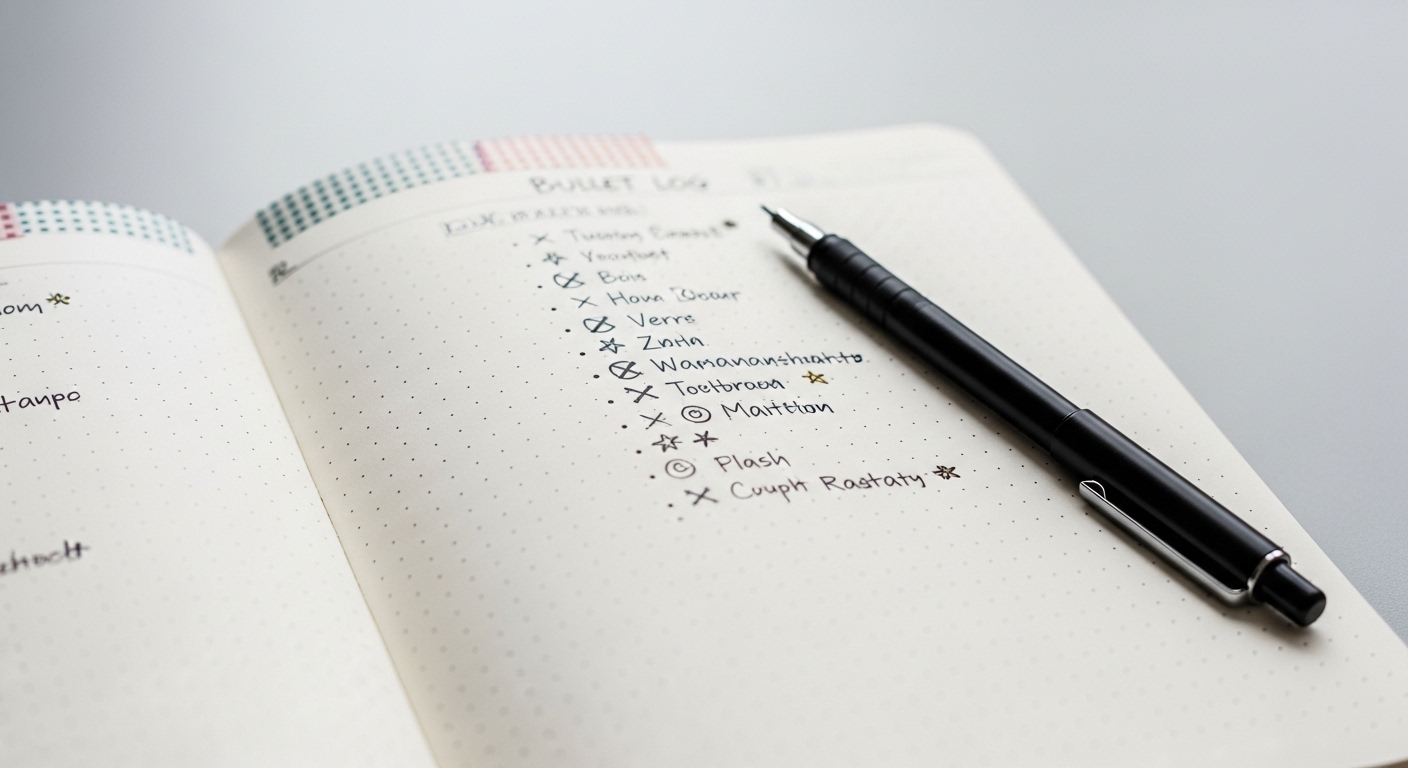
The humble to-do list is the oldest productivity tool in human history. But most people use it incorrectly — they create a massive “master list” of everything they need to do ever, and then feel overwhelmed into inaction.
An effective to-do list has these characteristics:
- It is written the night before, not improvised in the morning
- It contains no more than five to seven items per day
- Every item is a specific action, not a vague intention
- Items are numbered in priority order
- Incomplete items are consciously migrated to the next day with a mark indicating they were delayed
The discipline of keeping the daily list short is the most important habit. A list of three tasks you actually complete is infinitely more productive than a list of twenty tasks that paralyze you.
The Ivy Lee Method — Six Tasks a Day
Developed by productivity consultant Ivy Lee in 1918 for the Bethlehem Steel Corporation, this method remains one of the most powerful offline task management systems ever created. Its simplicity is its genius.
The Ivy Lee Method in five steps:
- At the end of each workday, write down the six most important tasks for tomorrow
- Rank them in order of true importance — number one is the most critical
- The next day, work through the list in order, starting with task one
- Do not move to task two until task one is fully complete
- At the end of the day, move any unfinished tasks to a fresh list for tomorrow
The method’s power lies in its forced prioritization and its insistence on single-tasking — working on one thing at a time until it is done. It requires no technology, no subscription, and no battery. It requires only a pen and a willingness to be disciplined.
Time Blocking on Paper
Time blocking is the practice of assigning specific time slots to specific tasks rather than working from an open-ended list. Cal Newport, author of Deep Work, is one of the method’s most prominent advocates, and he practices it entirely on paper.
To time block without an app:
- Draw a vertical timeline of your day on paper, from your start time to your end time, divided into 30-minute increments
- Assign blocks of time to specific tasks or categories of work
- Include buffer blocks between intensive tasks
- Treat each block like an appointment — you would not skip a meeting, so do not skip a focused work block
Time blocking on paper is more flexible than it sounds. You can cross out and rewrite blocks as the day evolves. The physical act of replanning — redrawing your schedule — makes you more aware of how you are spending your time, which is itself a powerful behavioral modifier.
The Eisenhower Matrix (Urgent-Important Grid)
The Eisenhower Matrix, attributed to President Dwight D. Eisenhower and popularized by Stephen Covey in The 7 Habits of Highly Effective People, divides all tasks into four quadrants:
| Urgent | Not Urgent | |
|---|---|---|
| Important | Do Now (Q1) | Schedule (Q2) |
| Not Important | Delegate (Q3) | Eliminate (Q4) |
Draw this grid on any piece of paper and categorize your tasks. The goal is to spend most of your time in Quadrant 2 — important but not urgent work — which includes strategic thinking, relationship building, learning, and prevention. Most people spend their days in Q1 (firefighting) and Q3 (other people’s urgencies), which leads to chronic stress and stagnation.
The Pomodoro Technique Without a Timer App
The Pomodoro Technique, developed by Francesco Cirillo in the late 1980s, breaks work into 25-minute focused sessions (Pomodoros) separated by 5-minute breaks. After four Pomodoros, you take a longer 15–30 minute break.
Without an app, you need only an analog kitchen timer — the tomato-shaped timer Cirillo himself used, hence the name “Pomodoro” (Italian for tomato). Write your task at the top of your session card, wind the timer to 25 minutes, and work until it rings. Tally completed Pomodoros with small marks next to your task.
This technique addresses Parkinson’s Law — the observation that work expands to fill the time available for its completion. By imposing a short, fixed time constraint, it creates urgency and focus.
The MIT (Most Important Task) Method
Developed by productivity blogger Leo Babauta, the MIT method is beautifully minimal: every morning, identify one to three Most Important Tasks for the day and commit to completing them before anything else.
MITs are not necessarily the most urgent tasks — they are the tasks that will have the greatest positive impact if completed. Write them at the top of your daily page, underline them, or star them. Everything else is secondary.
The Weekly Review Practice
David Allen’s Getting Things Done (GTD) framework, while often implemented digitally, works entirely on paper. Its most valuable offline component is the Weekly Review — a dedicated time (usually Friday afternoon or Sunday evening) to:
- Collect and process loose papers and notes
- Review your master project list
- Update your calendar
- Identify the week’s top priorities
- Clear mental clutter through a thorough brain dump
Doing this weekly review with pen and paper, without a screen, allows for deeper reflection and more honest self-assessment than clicking through digital menus.
How to Build a Paper-Based Productivity System Step by Step
Step 1 — Choose Your Medium
Pick one primary tool and commit to it for at least 30 days. Options:
- Dotted notebook (for Bullet Journal enthusiasts)
- Pre-structured daily planner
- Legal pad or spiral notebook (for minimalists)
- Index card stack (for the ultra-portable option)
- Whiteboard (for visual thinkers or households)
Do not let the choice of tool become a form of procrastination. A cheap composition notebook used consistently outperforms an expensive planner that sits unopened on a shelf.
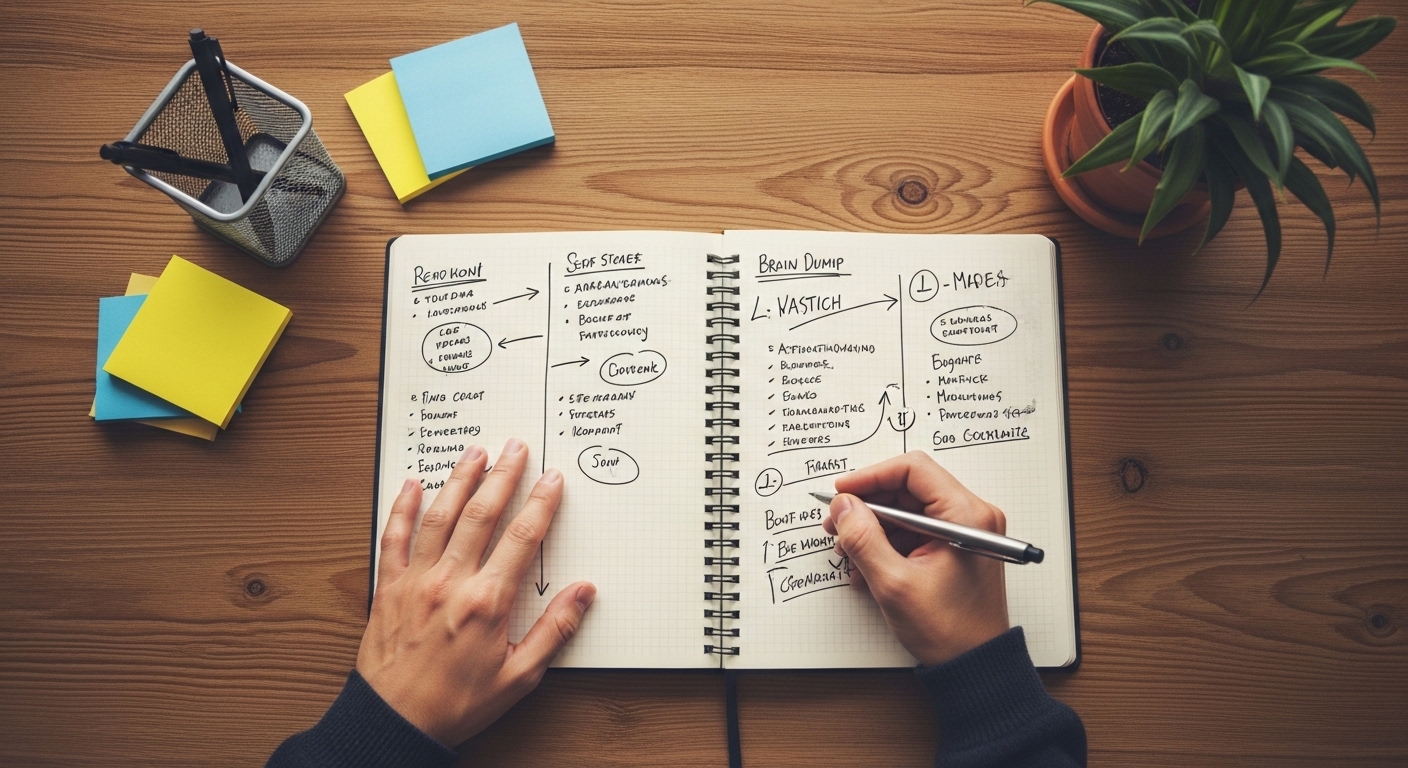
Step 2 — Create a Master Task List (Brain Dump)
Before organizing anything, do a complete brain dump: write down every task, obligation, project, errand, commitment, and idea that is taking up mental bandwidth. Do not organize yet — just get it out of your head and onto paper.
This process, central to David Allen’s GTD philosophy, leverages the psychological principle that your brain is better at processing information than storing it. Once tasks are externalized onto paper, cognitive load drops dramatically, and creative and analytical thinking improves.
Step 3 — Plan Your Day the Night Before
Every evening, spend five to ten minutes reviewing what happened today and preparing tomorrow’s list. Identify:
- What must absolutely be done tomorrow (commitments, deadlines)
- What do you want to do tomorrow (progress on meaningful projects)
- What you could do if time allows (nice-to-haves)
Write these in ranked order. Limit your must-do list to three to five items. This night-before planning practice is one of the most consistently recommended habits among high-performing professionals across industries.
Step 4 — Use Time Slots and Batching
Assign your tasks to specific time windows. Task batching — grouping similar tasks together in a single block — dramatically reduces the cognitive switching cost of jumping between different types of work. For example:
- 9:00–10:00 AM: All email and communication
- 10:00 AM–12:00 PM: Deep work on primary project
- 1:00–2:00 PM: Administrative tasks and calls
- 2:00–4:00 PM: Secondary project work
Draw this schedule on the left side of your notebook page and track actual time spent next to it on the right. The comparison between planned and actual time use is one of the most revealing productivity insights available — and it requires nothing more than a pen.
Step 5 — Track Progress and Carry Over Incomplete Tasks
At the end of each day, review your list:
- Cross out completed tasks (with satisfaction)
- Circle or arrow incomplete tasks to migrate to tomorrow’s list
- Note why tasks were not completed — this pattern reveals systemic issues (overplanning, distractions, unclear tasks)
In the Bullet Journal system, this migration process is called reflection, and it is built into the daily and monthly review cycles. Over time, if a task keeps getting migrated without completion, you are forced to consciously decide: Is this actually important, or should it be dropped entirely?
Managing Work Tasks Without Apps
How to Handle Meetings and Action Items on Paper
Bring a dedicated notebook to every meeting. Use a consistent format: date and meeting name at the top, action items marked with a star or box in the margin, owner and deadline noted next to each action item.
After the meeting, transfer your starred action items to your master task list or daily plan. This two-step capture-and-process habit ensures nothing falls through the cracks and that every meeting produces measurable follow-through.
Managing Project Tasks with a Notebook
Dedicate a section of your notebook to each active project. Use a simple structure:
- Project name and goal (one sentence)
- Key milestones or phases
- Running task list for the project
- Notes, decisions, and reference information
Review active project pages during your weekly review to ensure every project is moving forward. For those who want a deeper framework for structured project thinking, the principles behind project percentage completion tracking can also be applied manually using simple paper-based calculations.
Communicating Deadlines and Priorities Offline
In a work environment, you may need to communicate your task priorities to colleagues or managers. A handwritten one-page priority list, shared at the start of the week, is often more memorable and impactful than a digital update buried in a project management tool. Write it clearly, keep it visible on your desk, and update it at the start of each week.
Managing Personal and Home Tasks Without Apps
Household Chore Scheduling on Paper
A weekly chore rotation chart, posted in a visible location like the kitchen or a family bulletin board, distributes household tasks across days and family members without requiring any app. Use a simple grid: days of the week across the top, tasks down the left side, the responsible person’s initial in each cell.
Grocery Lists and Errands
The classic grocery list on a notepad has been refined by generations of practical use. Keep a notepad on the refrigerator or in a designated kitchen drawer. When something runs out, write it immediately — do not try to remember it later. Organize the list by store section (produce, dairy, frozen, etc.) to minimize time in the store.
For errands, maintain a running errand list in your notebook or planner. Before leaving the house, review it and batch all errands in the same area of town on the same trip.
Long-Term Goals and Monthly Planning Without Digital Tools
Use the first page of each month’s section in your planner or notebook for a monthly overview:
- Three to five major goals for the month
- Key dates and deadlines
- One personal habit or focus area
Review this page at the start of each week to ensure your daily tasks are aligned with your monthly intentions. This top-down planning approach — annual goals to monthly milestones to weekly priorities to daily tasks — is the foundation of virtually every effective productivity framework, from GTD to OKRs to the Full Focus Planner system.
Overcoming Common Challenges of Going App-Free
What to Do When You Forget Your Notebook
Carry a pocket notepad or a few folded index cards as a backup capture tool. When you are without your main notebook, jot notes on the backup card and transfer them to your primary system at the next opportunity. The goal is never to leave an idea or task floating in your head — capture it immediately, wherever you are, on whatever you have.
How to Handle Recurring Tasks Without Reminders
Create a recurring task checklist — a separate page or card that lists everything that happens on a regular schedule (weekly, monthly, quarterly). At the start of each week or month, copy relevant recurring tasks onto your active planning pages. This manual copying is intentional: it forces you to consciously decide whether the recurring task still makes sense, rather than blindly executing an automated reminder.
Staying Consistent Without Digital Accountability
The most common reason analog systems fail is inconsistency — the planner goes unused for a few days, and then feels too daunting to restart. To stay consistent:
- Keep your notebook visible — on your desk, not in a drawer
- Attach planning to an existing habit — coffee, lunch, end of workday
- Start small — even a three-item list is a win
- Give yourself permission to restart — a missed day is not a failed system; just continue
According to behavioral science research published in journals like Health Psychology, it takes an average of 66 days — not the commonly cited 21 days — to form a reliable new habit. Be patient with yourself during the initial weeks of adopting an analog system.
Tips, Habits, and Best Practices
How to Stop Procrastinating Without an App Nudging You
Without push notifications to start working, you need internal triggers and environmental design to beat procrastination.
- Use the two-minute rule: if a task takes less than two minutes, do it immediately when it surfaces
- Use the 5-4-3-2-1 launch rule: count down from five and physically start the task at “1” — no negotiating, no checking anything first
- Make the first action frictionless: open the notebook, put the pen in your hand, and start writing — momentum builds from there
- Remove competing stimuli: put your phone in another room, close unnecessary browser tabs, and create a physical workspace that signals “work mode”
Color Coding, Symbols, and Visual Cues
Visual organization transforms a plain notebook into a scannable, intuitive system. Common conventions include:
- Red or star: top priority / urgent
- Blue or circle: personal task
- Green or triangle: waiting for someone else / delegated
- Yellow highlight: reference information to review later
- Box: task to complete (checkbox style)
- Filled box: completed task
- Arrow: task migrated to another day
Consistency is the key — pick a system and stick to it so that reading your notebook becomes instant and reflexive.
Combining Analog and Minimal Digital (a Hybrid Approach)
For those who cannot go fully analog — particularly in professional environments that require shared calendars or collaborative tools — a hybrid approach works well. Use digital tools only for:
- Shared calendars (meetings others need to see)
- External communication (email, messaging)
And use paper for:
- Personal task management
- Deep work planning
- Creative thinking and brainstorming
- Daily and weekly reviews
This approach gives you the collaboration benefits of digital tools without the distraction costs of managing your personal productivity in the same screen environment where notifications live.
Conclusion
Managing daily tasks without apps is not a nostalgic retreat from modernity. It is a deliberate, evidence-based choice to use the oldest and most reliable productivity technology ever invented: pen and paper. From the Ivy Lee Method to bullet journaling, from the Eisenhower Matrix to time blocking on a legal pad, the analog approaches to task management have stood the test of time precisely because they are grounded in how human psychology actually works — not how software designers wish it worked.
The right system is the one you will actually use. Start simple, stay consistent, and give yourself the gift of a productivity practice that cannot be interrupted by a notification, drained by a dead battery, or disrupted by a software update.
External Reference: For a deeper understanding of the science behind handwriting and memory encoding, the research compiled by the Association for Psychological Science provides excellent reading on why handwriting enhances cognitive retention in ways that typing does not.
