
Summary: A percentage is a way to express a value as parts per hundred, making it easier to compare numbers, measure change, and understand discounts, marks, profit, tax, and statistics. In simple terms, you usually calculate a percentage by dividing the part by the whole and multiplying by 100. This guide explains the core percentage formula, easy mental math tricks, percentage increase and decrease, reverse percentage, common mistakes, and real-life use cases so beginners and advanced readers can solve almost any percent problem confidently. Khan Academy also defines percent as a ratio out of 100, which aligns with the standard mathematical meaning used throughout this guide.
Outline
What Is a Percentage?
- Basic Percentage Formula
- Easy Methods to Calculate Percentage
- How to Find the Percentage of a Number
- How to Find What Percent One Number Is of Another
- How to Calculate Percentage Increase
- How to Calculate Percentage Decrease
- How to Calculate Percentage Change
- How to Calculate Reverse Percentage
- Percentage in Exams, Business, and Daily Life
- Percentage to Decimal and Fraction Conversions
- Common Percentage Formulas You Should Know
- Common Mistakes in Percentage Calculation
- Tips to Calculate Percentages Faster
- Frequently Asked Questions About Percentages
- Final Thoughts
How to Calculate Percentage (Easy and Simple Methods)
What Is a Percentage?
Meaning of percent
A percentage means “per hundred.” The symbol % represents a number out of 100. So, 25% means 25 out of every 100, and 60% means 60 out of every 100.
Why percentages matter in everyday life
Percentages are used almost everywhere. You see them in exam results, shopping discounts, loan interest, tax, business profit, data reports, nutrition labels, and election surveys. They make comparisons easier because everything is measured on the same base: 100.
Percentage vs fraction vs decimal
A percentage, a fraction, and a decimal can all represent the same value:
- 50% = 50/100 = 0.50
- 25% = 25/100 = 1/4 = 0.25
- 75% = 75/100 = 3/4 = 0.75
Understanding this relationship makes percentage calculation much easier.
Basic Percentage Formula
The standard formula: part ÷ whole × 100
The most important formula is:
Percentage = (Part / Whole) × 100
This is the master formula behind most percent problems.
For example, if 20 students out of 50 passed:
Percentage = (20 / 50) × 100 = 40%
Understanding part, whole, and rate
- Part = the smaller amount or portion
- Whole = the total amount
- Rate = the percentage
If you understand these three terms, most percentage questions become straightforward.
When to multiply first and when to divide first
In most cases, divide the part by the whole first, then multiply by 100.
If the numbers are simple, you can sometimes simplify early to save time.
Example:
(25 / 200) × 100
= 0.125 × 100
= 12.5%
Easy Methods to Calculate Percentage
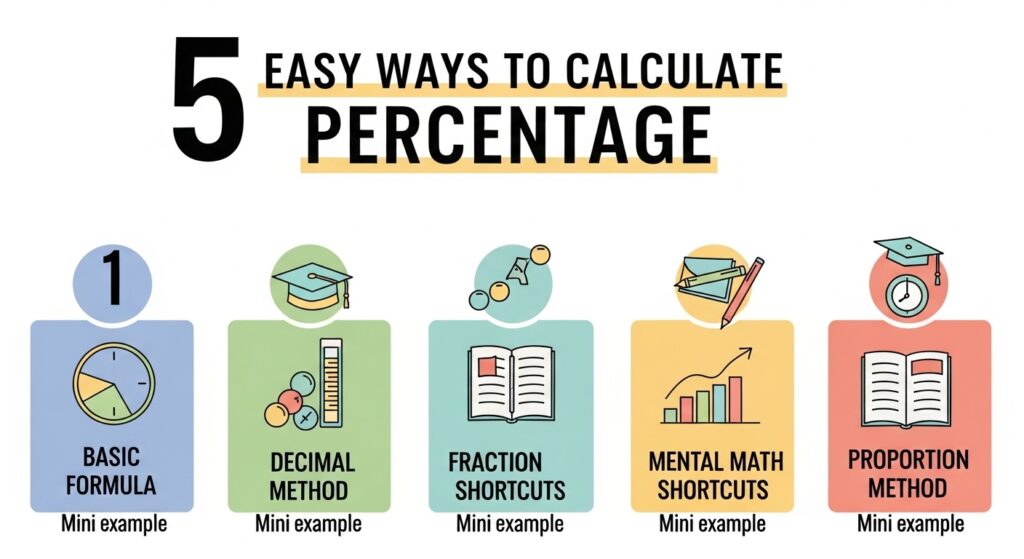
Method 1: Using the basic formula
This is the standard and most reliable method.
Formula:
Percentage = (Part / Whole) × 100
Example: What percentage is 18 out of 24?
= (18 / 24) × 100
= 0.75 × 100
= 75%
This method works well for school math, reports, and any exact percentage problem.
Method 2: Converting percentage to decimal
To find a percentage of a number, convert the percent into a decimal first.
Formula:
Percentage of a number = Decimal form of percent × Number
Example: Find 30% of 80
30% = 0.30
0.30 × 80 = 24
This is one of the easiest methods for practical calculations.
Method 3: Using fractions
Some percentages are easier as fractions:
- 50% = 1/2
- 25% = 1/4
- 75% = 3/4
- 10% = 1/10
- 20% = 1/5
Example: Find 25% of 200
25% = 1/4
200 ÷ 4 = 50
Method 4: Mental math percentage shortcuts
Mental math is useful for common percentages:
- 10% of 90 = 9
- 20% of 90 = 18
- 50% of 90 = 45
- 1% of 90 = 0.9
- 5% of 90 = half of 10% = 4.5
By combining easy percentages, you can calculate harder ones.
Example: Find 15% of 80
10% of 80 = 8
5% of 80 = 4
15% = 8 + 4 = 12
Method 5: Using proportion and cross multiplication
You can also use proportions:
x% of y means x/100 = part/whole
Example: What percent of 60 is 18?
x / 100 = 18 / 60
x = (18 × 100) / 60
x = 30%
This method is useful for students who prefer ratio-based solving.
How to Find the Percentage of a Number
Finding 10%, 20%, 25%, 50%, and 75%
These are the most practical benchmark percentages:
- 10%: move the decimal one place left
- 20%: find 10% and double it
- 25%: divide by 4
- 50%: divide by 2
- 75%: find 50% + 25%
Examples:
- 10% of 500 = 50
- 20% of 500 = 100
- 25% of 500 = 125
- 50% of 500 = 250
- 75% of 500 = 375
Finding any percentage of an amount
Use:
(Percentage / 100) × Number
Example: Find 18% of 250
= (18 / 100) × 250
= 0.18 × 250
= 45
Fast calculation examples
- 12% of 150 = 18
- 8% of 400 = 32
- 65% of 200 = 130
- 2.5% of 800 = 20
For quick calculations and instant results, readers can also use this internal tool: Percentage Calculator Free Online.
How to Find What Percent One Number Is of Another
Compare one value to another
This question appears in many forms:
- What percent is 30 of 120?
- 45 is what percent of 90?
- 12 out of 48 equals what percentage?
Use the same core formula:
(Part / Whole) × 100
Formula and examples
Example 1: What percent is 30 of 120?
= (30 / 120) × 100
= 0.25 × 100
= 25%
Example 2: 45 is what percent of 90?
= (45 / 90) × 100
= 0.5 × 100
= 50%
Interpreting the answer correctly
Always identify the total value correctly. If you use the wrong whole, the percentage will be wrong. This is one of the most common errors in percentage word problems.
How to Calculate Percentage Increase
Increase formula
Use this formula when a value rises:
Percentage Increase = ((New Value – Original Value) / Original Value) × 100
Price increase examples
A product price rises from 80 to 100.
= ((100 – 80) / 80) × 100
= (20 / 80) × 100
= 25%
So, the price increased by 25%.
Salary and growth rate examples
A salary increases from 40,000 to 46,000.
= ((46,000 – 40,000) / 40,000) × 100
= (6,000 / 40,000) × 100
= 15%
The salary increase is 15%.
How to Calculate Percentage Decrease
Decrease formula
Use this when a value falls:
Percentage Decrease = ((Original Value – New Value) / Original Value) × 100
Discount and markdown examples
An item drops from 200 to 150.
= ((200 – 150) / 200) × 100
= (50 / 200) × 100
= 25%
So, the item has a 25% discount or 25% decrease.
Marks reduction and value drop examples
If marks go from 90 to 72:
= ((90 – 72) / 90) × 100
= (18 / 90) × 100
= 20%
The marks decreased by 20%.
How to Calculate Percentage Change
Difference between increase, decrease, and change
Percentage change measures how much a number has changed relative to its original value. It can be an increase or a decrease.
Formula:
Percentage Change = (Difference / Original Value) × 100
Absolute change vs relative change
- Absolute change = actual difference in numbers
- Relative change = percentage difference compared to the original value
Example: from 50 to 60
- Absolute change = 10
- Percentage change = (10 / 50) × 100 = 20%
When percentage change is useful
This is especially useful in:
- sales reports
- stock or price movements
- student performance
- website traffic growth
- business analytics
How to Calculate Reverse Percentage
Find the original value before the discount
Reverse percentage means working backward.
If a shirt costs 80 after a 20% discount, then 80 is 80% of the original price.
So:
Original Price = Final Price / Remaining Percentage
= 80 / 0.80
= 100
Find the original price before tax or markup
If a price becomes 115 after adding 15% tax, then 115 is 115% of the original.
Original Price = 115 / 1.15
= 100
Reverse percentage formula with examples
- After a 30% discount: divide by 0.70
- After a 25% increase: divide by 1.25
- After a 12% tax: divide by 1.12
This method is useful for original price, pre-tax value, and before-discount calculations.
Percentage in Exams, Business, and Daily Life
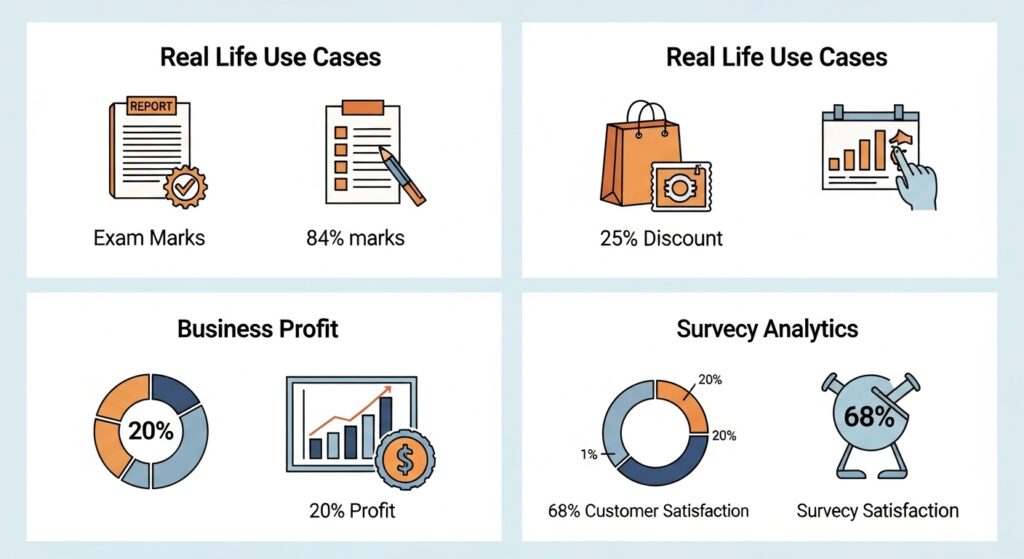
Marks and grades
To calculate the marks percentage:
(Marks Obtained / Total Marks) × 100
Example: 420 out of 500
= (420 / 500) × 100
= 84%
Discounts, tax, and tips
Percentages are used in shopping and billing every day:
- sale discount
- VAT or sales tax
- service charge
- restaurant tip
Example: 10% tip on 1,200
= 120
Profit margin and loss percentage
For business calculations:
Profit Percentage = (Profit / Cost Price) × 100
Loss Percentage = (Loss / Cost Price) × 100
If the cost price is 500 and the selling price is 600:
Profit = 100
Profit % = (100 / 500) × 100 = 20%
Survey data and statistics
Percentages help summarize data clearly:
- 68% of customers were satisfied
- 42% of users clicked the button
- 15% growth month over month
This is why percentages are common in statistics, dashboards, and market research. For readers who want a broader educational explanation of percent concepts and visual learning, a useful external resource is Khan Academy’s percentages lessons.
Percentage to Decimal and Fraction Conversions
Percent to decimal
Divide by 100.
- 45% = 0.45
- 7% = 0.07
- 125% = 1.25
Decimal to percent
Multiply by 100.
- 0.6 = 60%
- 0.125 = 12.5%
- 1.4 = 140%
Fraction to percent
Convert the fraction to a decimal, then multiply by 100.
- 1/2 = 0.5 = 50%
- 3/4 = 0.75 = 75%
- 1/8 = 0.125 = 12.5%
Percent to fraction
Write the percent over 100, then simplify.
- 20% = 20/100 = 1/5
- 75% = 75/100 = 3/4
- 5% = 5/100 = 1/20
Common Percentage Formulas You Should Know
Percentage of a number
(Percent / 100) × Number
Find percentage
(Part / Whole) × 100
Percentage increase
((New – Original) / Original) × 100
Percentage decrease
((Original – New) / Original) × 100
Profit percentage
(Profit / Cost Price) × 100
Loss percentage
(Loss / Cost Price) × 100
Original value after discount
Final Value / (1 – Discount Rate)
Original value after increase
Final Value / (1 + Increase Rate)
These formulas cover nearly all the same-intent search topics, including:
- How to calculate a percent
- percentage formula
- How to find a percentage
- percent of a number
- percentage increase formula
- percentage decrease formula
- reverse percentage formula
- original price before discount
- How to calculate the discount percentage
- How to work out percentages
Common Mistakes in Percentage Calculation
Mixing up part and whole
If the whole and part are reversed, the answer becomes incorrect.
Forgetting to multiply by 100
Many learners stop after division and forget to convert to a percent.
Example:
15 / 60 = 0.25
Correct percentage = 25%, not 0.25%
Confusing percentage points with percent change
A rise from 10% to 15% is:
- 5 percentage points
- 50% increase relative to 10%
These are not the same.
Using the wrong base value
For increase and decrease, always divide by the original value, not the new value.
Tips to Calculate Percentages Faster
Mental math shortcuts
Use easy anchors:
- 1% = divide by 100
- 10% = shift decimal left
- 5% = half of 10%
- 15% = 10% + 5%
- 75% = 50% + 25%
Rounding for estimates
For quick estimation, round numbers slightly.
Example: 19% of 198 is close to 20% of 200 = 40
Using benchmark percentages
Common benchmark values:
- 10%
- 25%
- 50%
- 75%
- 100%
These make shopping, budgeting, and mental calculations much easier.
Checking answers quickly
Ask:
- Is the result reasonable?
- Is the percentage more than 100% or less than 100%?
- Did I use the right whole?
- Did I convert the percent correctly?
Frequently Asked Questions About Percentages
How do you calculate a percentage quickly?
The fastest method is usually:
(Part / Whole) × 100
Or, for finding a percent of a number:
Decimal form × Number
What is the easiest percentage formula?
The easiest formula is:
Percentage = (Part / Whole) × 100
How do you calculate a percentage without a calculator?
Use mental math:
- 10% by moving the decimal
- 5% by halving 10%
- 1% by dividing by 100
Then combine values as needed.
How do you find the original number from a percentage?
Use reverse percentage:
- After discount: divide by the remaining decimal
- After increase: divide by the increased decimal
Example: final value 72 after 20% discount
Original = 72 / 0.80 = 90
Final Thoughts
Key takeaways
Percentage problems become easy once you understand that percent means “out of 100.” Nearly every calculation comes back to one idea: compare a part with a whole, or apply a rate to a value.
Best method for beginners
For beginners, the best approach is:
- Identify the part and whole
- Choose the correct formula
- divide carefully
- multiply by 100 if needed
When to use an online tool
If you want to save time or avoid manual mistakes, a calculator can help, especially for reverse percentage, discount, tax, markup, and percentage change problems. The Percentage Calculator Free Online is a practical option for quick checks.
